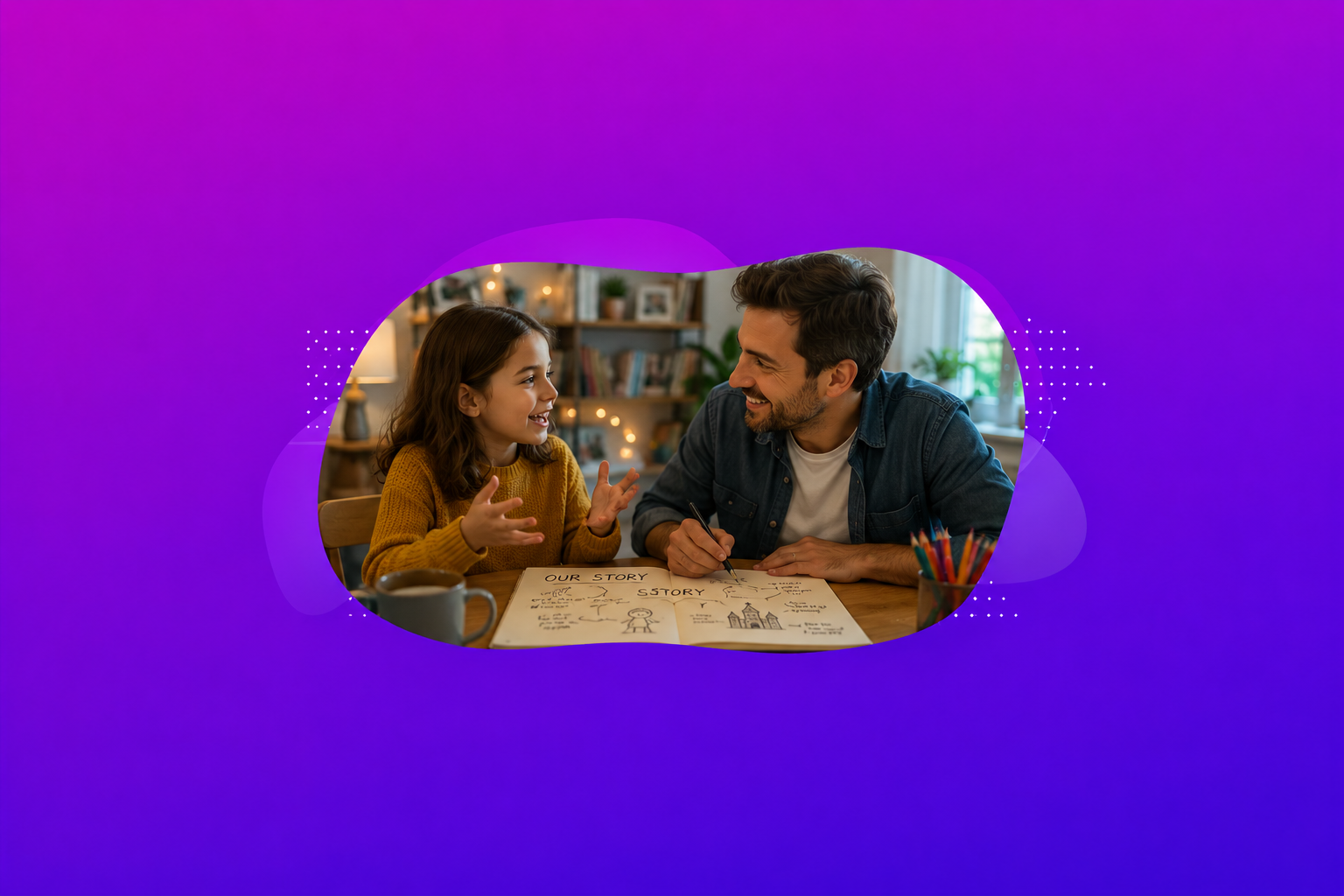
Collaborative storytelling is when a child and another person — a parent, sibling, teacher, or friend — build a story together, taking turns adding characters, choices, and plot twists. Unlike being read to, the child is a co-author. They decide what happens next, and someone else responds to it.
That last part is the whole thing. And it is doing more work than most parents realize.
Why “collaborative” is the part that matters
Ask a seven-year-old to make up a story alone and you will usually get about four sentences. A dragon appears. The dragon is big. Someone fights the dragon. The end.
Now sit down and build it with them. Ask why the dragon came. Ask what the dragon is afraid of. Suddenly the story has a reason, a problem, and a shape — and your child is generating almost all of it. You did not supply the ideas. You supplied the questions that made room for the ideas.
Solo storytelling vs. building a story together
Solo storytelling asks a child to invent and structure and narrate, all at once. That is a heavy cognitive load, and most kids under ten cope by keeping it short and safe.
Collaborative storytelling splits the job. Your child brings the imagination. You quietly hold the structure — “wait, what happened to the sister?” — and hand it back. They get to be more inventive precisely because they are not carrying the whole thing alone.
The scaffolding effect
Educators have a word for this: scaffolding. You provide just enough support that the child can operate slightly above their independent ability, then you gradually remove it.
It is the same principle behind dialogic reading, where instead of reading at a child, the adult asks open questions and expands on what the child says. The child does more of the talking. The adult does more of the listening.
This is also why storytelling works best as something you do with your kid rather than something you hand them. It is the same logic behind games you can play with your kid, not just watch them play — the adult presence is not supervision, it is participation.
What the research actually shows — and what it doesn’t
Here is where most parenting articles start overclaiming. So let us be careful, because the honest picture is still a good one.
The strong evidence: narrative skills and later reading
There is solid, repeated evidence that children’s narrative skills — their ability to construct and follow a story — are a meaningful predictor of later reading comprehension and academic outcomes. This shows up consistently in the early-literacy literature, and it holds across multiple longitudinal studies.
Alongside it, dialogic and interactive reading interventions — the adult-asks, child-answers, adult-expands pattern — have been shown to improve children’s vocabulary, listening comprehension, and the structure of the stories they tell. That is a real, well-replicated finding.
The honest caveat: correlation is not causation
Now the part nobody puts in the headline. Researchers who have looked closely note that while the correlation between story construction ability and literacy is moderate-to-strong, the causal evidence — that doing more shared storytelling makes kids better readers — is thinner than the enthusiasm around it suggests.
So no, we cannot honestly tell you that twenty minutes of making up dragon stories will raise your child’s reading level. What we can say is that storytelling together builds the exact skills — sequencing, cause and effect, character motivation, vocabulary in context — that strong readers rely on, and that it is a well-supported way to spend the time.
That is a less exciting claim. It is also a true one.
Where pediatric guidance lands
The American Academy of Pediatrics has steadily moved away from framing children’s media as a stopwatch problem. Its guidance now emphasizes quality, context, and conversation over raw time limits, and consistently highlights the value of caregivers engaging with children around media rather than leaving them to it alone.
The practical translation for parents: an hour of building a story with your child is not the same category of thing as an hour of scrolling, even if the clock says otherwise. What matters is whether there is a person on the other side of the activity.
Five ways to build a story together tonight
None of these need materials, preparation, or a screen.
1. “And then it got worse.”
Your child starts a story. Every time they pause, you say: “and then it got worse.” Their job is to escalate. This teaches rising action, and children find it hilarious.
2. The one-sentence relay.
Strict turn-taking, one sentence each. You cannot skip your turn and you cannot undo theirs. The constraint is what makes it work — your child has to build on something they did not choose.
3. Interview the character.
Before any plot happens, your child invents a character. Then you interview them, in role. What are you scared of? What is in your pocket? Who are you looking for? A character with a want is a story engine. A character without one is a drawing.
4. The wrong ending.
Retell a story they already know — but you deliberately get the ending wrong. They will correct you, loudly. Then ask them what ending they would have written instead.
5. Three objects.
Grab three random things from around the room. The story must include all three. Constraints do not limit creativity in kids; they give it somewhere to push against.

What this looks like at different ages
Ages 6–7
- What they can do: Strong on invention, weak on structure. Stories jump around and often stop rather than end.
- Your role: Hold the thread. Gently remind them of things they introduced and forgot.
- A prompt that works: “Wait — what happened to the rabbit from before?”
Ages 8–9
- What they can do: Beginning to grasp cause and effect. They can sustain a plot but tend to resolve conflict instantly.
- Your role: Slow down the resolution. Make the problem harder before it gets solved.
- A prompt that works: “That was almost too easy. What could go wrong now?”
Ages 10–12
- What they can do: Genuine character motivation, subplots, and an emerging sense of tone.
- Your role: Step back. Become an audience member and a challenger, not a co-author.
- A prompt that works: “Why would she do that, though? What does she actually want?”
Common mistakes parents make
Taking over. The most common failure. You have a better idea, you say it, and the story becomes yours. Children notice immediately and disengage. If you find yourself supplying more than a third of the ideas, stop talking and ask a question instead.
Correcting the logic. Yes, the dragon cannot be underwater and also on the mountain. Let it go. Internal consistency is a skill children develop by noticing the problem themselves, not by having it pointed out.
Reaching for a screen as a substitute for presence. Digital tools can genuinely support collaborative storytelling — there are tabletop games like Rory’s Story Cubes and Once Upon a Time, and online options like Storybird or Mysh that are built around a child and an adult creating something jointly rather than the child playing alone. But the tool is not the point. The other person is the point. Anything designed to hold your child’s attention instead of yours — which is most ad-supported kids’ games — is working against you, not with you.
Asking for “a story” cold. It is a blank-page request, and it intimidates children the same way it intimidates adults. Give them a character, an object, or a problem. Never an empty page.
The short version
Building stories with your child is not a shortcut to better grades, and anyone promising that is overselling it. What it is: one of the few activities where your child does the creative work, you do the listening, and the skills that get exercised — sequencing, empathy, cause and effect, language under pressure — are the same ones that show up years later in how well they read and how clearly they think.
It also costs nothing and works in a car.
If you are looking for structured ways to do this — tabletop, screen-free, or online — start with our full guide to storytelling games for kids.
Frequently asked questions
What age can kids start collaborative storytelling?
Around four, if you are doing most of the structural work. By six or seven, most children can hold a simple plot with an adult prompting them. There is no ceiling — the activity just changes shape as they get older.
Is collaborative storytelling the same as reading together?
No, and the difference matters. Reading together means following someone else’s story. Collaborative storytelling means generating one. Reading builds comprehension; storytelling builds construction. Both are worth doing, and dialogic reading — where you ask open questions instead of just reading the words — sits usefully in between.
Does my child need to be a good writer for this to work?
Not at all. Almost all collaborative storytelling with children under ten should be spoken, not written. Writing introduces spelling anxiety and slows everything down. Talk first. Write later, if ever.
My child says they have no ideas. What do I do?
That is nearly always a blank-page problem, not an imagination problem. Do not ask for a story. Hand them a constraint: three objects, a character with a strange job, or a first line. Ideas arrive when there is something to push against.
Can screen-based games count as collaborative storytelling?
They can, if an adult is actually participating rather than supervising. The test is simple: are you contributing to the story, or are you watching your child play? If it is the second one, the tool is not doing what you hoped.
How long should a session be?
Ten to fifteen minutes is plenty, and stopping while your child still wants to continue is a feature, not a failure. Momentum matters more than duration.